04.05.2026
On Bad Asia Takes
Why are there so many bad Asia takes in Silicon Valley and Washington D.C.?

Asia is on America's mind again.
In Silicon Valley, China now undergirds an absurd amount of conversation: chips, export controls, EVs, humanoid robotics, rare earths, industrial policy, open-source AI. The frenzied post from a startup founder or technologist who has just come back from Shenzhen has become a common meme.

It’s also permeated into broader popular society: Gen Z and Millennials have been living through a particularly Chinese moment in our lives—binging Chongqing cyberpunk shorts, getting radicalized by Japan trips into mixed-use urbanism, and fleeing one TikTok for Xiaohongshu.
Japan, meanwhile, has become the object of fantasy: part urbanist pilgrimage site, part aesthetic antidote to American disorder, part proof that we don't have to live like this in the West.

This is all driving people a little insane.
Of course, none of this attention is baseless. China really is central to the strategic, geopolitical, and economic challenges of the century. Japan really is unusually good at some things the United States is not. The problem is not the interest—it is how often that interest gets filtered through historical amnesia, blanket generalization, and essentialist explanation.
In 1989, 68 percent of Americans told pollsters that Japan posed a greater threat to the future of the United States than the Soviet Union. American industry, in turn, rushed to absorb terms like kaizen, genba, and muda in the hope that Japanese industrial prowess might be smuggled home through buzzwords.
As recently as 1991, geopolitical analysts were writing books like The Coming War with Japan forecasting a shooting war between the U.S. and Japan, to the consternation of most Japanese observers.

The underlying explanatory habit has proven surprisingly durable: techno-orientalism discourse has stayed a primary framing device despite the baton changing hands almost seamlessly between Japan and China as object of exotic futurism and source of civilizational threat.
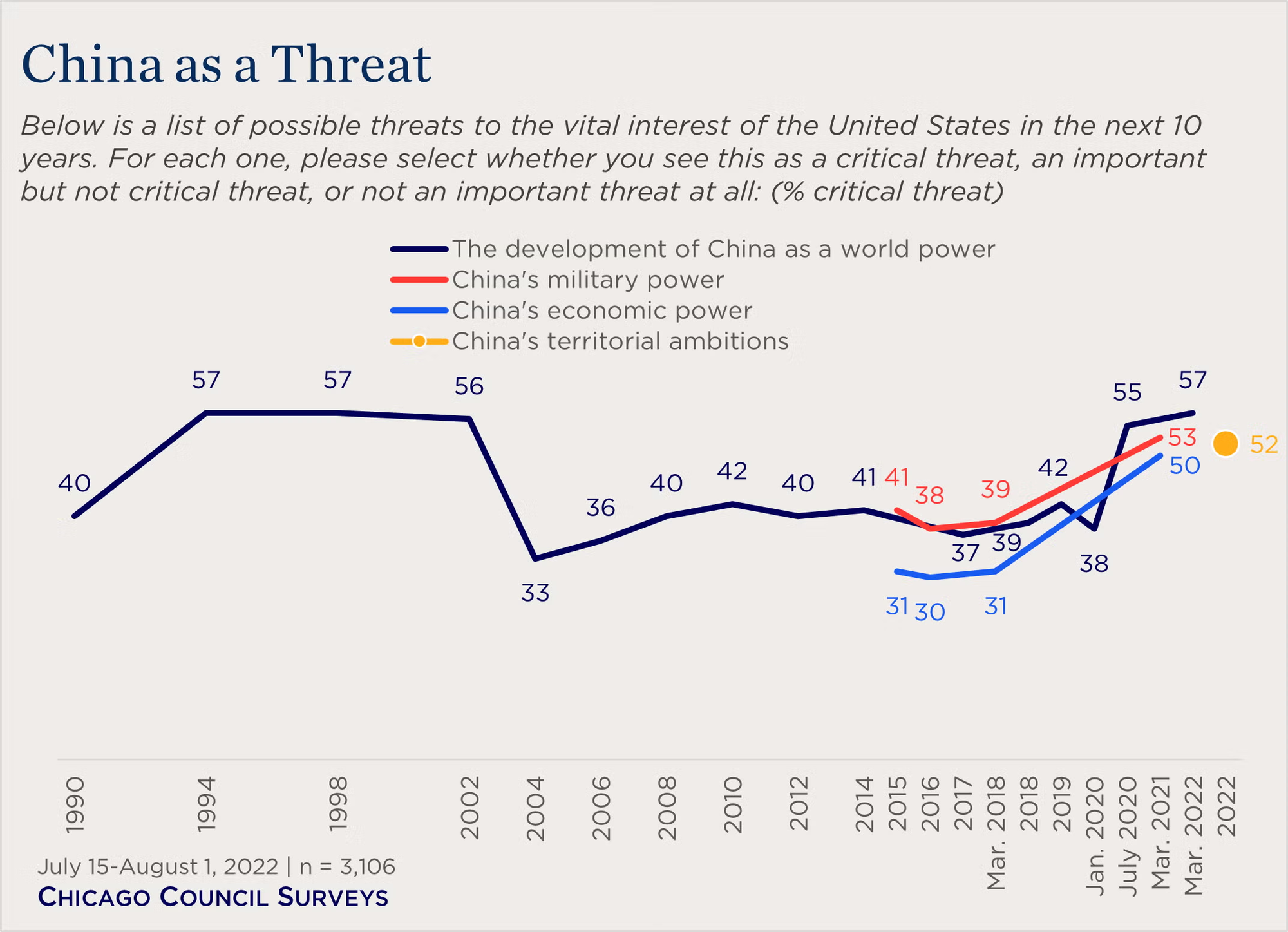
Silicon Valley’s current fixation on China and Asia more broadly is not just a business ecosystem talking to itself. As the tech elite extends its ambitions into adjacent corridors of power, Silicon Valley hot takes increasingly bleed into Washington conversations about industrial policy, national security, geopolitics, and state capacity.
Silicon Valley concerns with China are also fairly recent in its present form. Before the late 2010s, China was often treated by the Valley less as a civilizational rival than as a market, a manufacturing base, a source of capital, or a hardware ecosystem to learn from. Around 2019, that changed. Public opinion in the United States turned sharply more negative amid the trade war; Pew found unfavorable views of China jumped from 47 percent in 2018 to 60 percent in 2019, the largest one-year shift in its polling since it began tracking the question.
At roughly the same moment, China ceased to function in elite American discourse as merely a place to sell into or build in and became something else: a benchmark for industrial power, a proxy for American decline, and a recurring answer to the question of why the United States no longer seems able to build at speed or scale.
That helps explain why the discourse has become so fevered. Once semiconductors, batteries, logistics, and supply chains are understood not simply as sectors but as strategic capabilities, China moves inexorably toward the center of elite American attention. It becomes a competitor, a threat, and a mirror all at once.
This is part of what makes the conversation so unstable. China is not only being discussed as a country; it is also being used as a device for talking about the West — about what it can no longer build, what it can no longer coordinate, and what forms of ambition it still knows how to admire. Civilizational tropes have hardened from these anxieties - Chinese discipline, Asian industriousness, Western softness, Western decadence.
Similarly, discourse on Japan seems to reflect a deep dissatisfaction with disorder at home: with fraying public order, declining quality of life, institutional drift, and the everyday abrasions of American urban life. Other Asian societies enter the conversation occasionally selectively — Taiwan through TSMC and geopolitics, Korea through Samsung and pop culture.
In all cases, however, I've felt that the characterizations of these countries seem flat and one-dimensional, even with greater travel, trade, and cultural exposure, questionable mental models about Asia remain stubbornly persistent. There is often a remarkable mind-blindness about what makes Asia tick even with very well-traveled and intelligent investors/founders/policymakers.
Part of this is straightforward—distance, language gaps, and shallow exposure flatten understanding. If you do not read Chinese, Japanese, or Korean, have never lived in these societies, and know them mainly through English-language media, curated factory tours, and Tokyo vacations, then culture or IQ or a distribution of in-born personality types become an all-purpose explanation.
That is how people end up imagining China’s ‘social credit system’ as a single omnipotent score governing everyday life. In reality, what exists is a fragmented and evolving set of blacklists, regulatory enforcement tools, and local experiments—more legible as a patchwork of administrative mechanisms than as a science-fiction master score.
It's like exoticizing FICO or court orders.
There is a deeper problem with all of this: too much of the discourse on Asia leans on singular, unfalsifiable explanations that have become a way to explain outcomes without digging deeper into understanding institutions, structural incentives, and the broader context that generate those outcomes.
What worries me most is that so much of this seems rooted in either fear or blind admiration.
Economic Success and Asian Grind Culture
When trying to explain why China was so poor at the turn of the last century, Max Weber's The Religion of China (1915) argues that Confucianism was fundamentally incompatible with capitalism and modernization.
“Both the Puritan and the Confucian were 'sober men.' But the rational sobriety of the Puritan was founded in a mighty enthusiasm which the Confucian lacked completely; it was the same enthusiasm which inspired the monk of the Occident. The rejection of the world by occidental asceticism was insolubly linked to its opposite, namely, its eagerness to dominate the world.”
For decades, serious people recycled versions of that argument—then Japan, Korea, Taiwan, Hong Kong, and Singapore industrialized at extraordinary speed and drove sustained growth faster than any economy before, and the sign flipped! Suddenly Confucianism was no longer the obstacle. It was the secret sauce: discipline, hierarchy, thrift, education, collective effort.
The economic rise of China after the 1970s was now inevitable—because how could it not be?
Similarly, a narrative around Asian grind culture and 996 has taken root in Silicon Valley, with different parties respectively horrified and highly admiring. Prominent figures in the tech world, including Sequoia’s Mike Moritz in his at-the-time much discussed 2018 Financial Times op-ed—have urged Silicon Valley to treat Chinese work ethic as a competitive lesson rather than an institutional outcome.
My concern is not with effort or intensity as such—it's obviously an advantage to have a dedicated and enthusiastic team to win in a competitive space. It is with the ease with which work intensity gets elevated into a civilizational explanation — and then exported back as a policy prescription — without much regard for the institutional conditions under which that intensity emerged
Asian industriousness itself, which the world collectively takes as just a given, is the product of particular historical and economic outputs.
Japan is now imagined, especially from abroad, as a place of unusual punctuality and conscientiousness. Yet nineteenth-century visitors often described something rather different. Karl Scherzer, writing in 1869, found the Japanese comparatively pleasure-seeking and lacking in industriousness. Ernest Satow noted in the 1860s that clocks and punctuality were uncommon. The Dutch naval officer Willem Huyssen van Kattendijke, stationed in Nagasaki in the 1850s, complained in his journals about the slow pace of workers, their frequent tea breaks, and their lack of urgency.
What later came to seem cultural and ancient was, in many respects, modern and made - as Hashimoto and Kuriyama argue in The Birth of Tardiness, the concept of tardiness had to be invented in Japan, as it had to in other countries.
The Meiji government forced punctuality on the population through mandatory school bells, factory whistles, and strict railway schedules. The point is not just that punctuality became more important. It is that even tardiness had to be socially constructed as a recognizable problem. The Meiji state imposed new forms of time discipline through schools, factories, military organization, railways, and bureaucratic routines.
In its reinvention of itself as a modern nation, Japan would rather people forget that as recently as the 1970s, Tokyo had massive landfills of raw unprocessed garbage sites with massive fly infestations so severe that it closed down several local schools for months, with violent conflicts between residents and authorities over the construction of trash incinerators in their wards.

Japan is now often treated as proof that advanced societies need not descend into visible disorder. That much is understandable. But admiration quickly becomes fantasy, and fantasy is a poor guide to explanation - a lot of what people now talk about as timeless Japanese discipline and conscientiousness was a political achievement of modernity.
Similar efforts were made in South Korea: the Saemaul Undong (New Village Movement) in the 1960s-70s in South Korea was a national campaign by Park Chung-hee's military government to instill discipline and self-sacrifice in the rural population—government slogans plastered on every village wall, mandatory community labor projects, working hours pushed to among the longest in the world by design.
China’s case is even more recent: the work culture associated with China today is very much the product of a much newer institutional order: market liberalization, export-oriented industrialization, mass rural-to-urban migration, the partial rollback of the old danwei system, harsh interregional competition, weak welfare provision, exam pressure for limited university seats, and a political economy in which relentless striving was both materially incentivized and ideologically praised.
What gets described as an inherent work ethic is, in its present form, a new phenomenon whose emergence is highly tied to a developmental state powered by catch-up, export-oriented manufacturing, in a competitive labor-abundant environment and high economic growth.
Much of what is now described as East Asian culture was not the precondition for the developmental model. It was one of its outputs - it is downstream of the institutions, not upstream. And when the institutional bargain breaks down, the culture changes too—which is exactly what 躺平 (lying flat), satori, and N-po represent. These are not so much an abandonment of “Asian values” by a subset of the youth as much as a rational response to diminishing incentives.
In Search of Better Frameworks
If essentialist explanations are this unreliable, then we need better ones.
That does not mean pretending culture is irrelevant. It means contextualizing culture from a blanket first cause to one variable among others, and often not the decisive one. It means taking institutions, incentives, industrial structure, capital allocation, labor markets, firm organization, supplier networks, technology transfer, and geopolitical context more seriously than civilizational mood music.
It also means being more precise about the thing we are trying to explain. East Asia is not uniformly good at everything. It is not uniformly bad at everything either. Japan is not Taiwan is not China is not Korea. Manufacturing scale is not consumer internet dynamism. Discipline does not immediately equate to semiconductor dominance. Conformity is not quality control. These categories get blurred constantly, and then people act surprised when their grand theories explain very little.
I came across a particularly poignant quote in an opinion piece in The Guardian from a few years ago:
"I was at dinner with a friend, and she asked about my work. “Name one thing you wish Americans knew about China,” she said.
“That the Chinese people are people,” I replied.
The question that serious people should not be asking—especially people looking at reindustrialization or orderly streets—is not: "What is it about Asians?" That is a junk question.
A better question is: under what historical and institutional conditions did some East Asian societies become exceptionally good at manufacturing, process discipline, and industrial scaling? And what happened when those conditions weakened, changed, or ran into their own limits?
That is a structural question, not a civilizational one. It doesn’t fit neatly into a single meme or a single rallying cry, but has broader explanatory power that can actually be applied elsewhere.
In broad terms, East Asia’s postwar miracle economies were responding to a specific developmental challenge: how to close the productivity gap with richer countries quickly. That problem favored institutions optimized for disciplined execution, export manufacturing, technology absorption, and variance reduction.
It also unfolded in an unusually favorable international environment: expanding global trade and declining tariffs under GATT, access to foreign markets and technology, geopolitical backing during the Cold War, and decades of rising demand.
Those institutions were extraordinarily successful at generating catch-up growth. But the same institutions can become constraints when value shifts toward branding, platforms, domestic service productivity, and other forms of frontier innovation—and also have broad-ranging social impacts. In other words, what looks like “Asian culture” from a distance often turns out to be the social residue of a particular development model—and can also be observed in other non-Asian countries pursuing a similar model.
And once you see that, you start to notice versions of the same pattern outside Asia too. What exactly is the broader environment or institutional incentives that the United States or Germany or Italy operates under?
That, to me, is a much better place to start.
In the next essay, I’ll give a stab at a look at this mechanism and the dynamics around it!