04.09.2026
Taiwanese Urbanity
A short look at a specific neighborhood in Taipei.

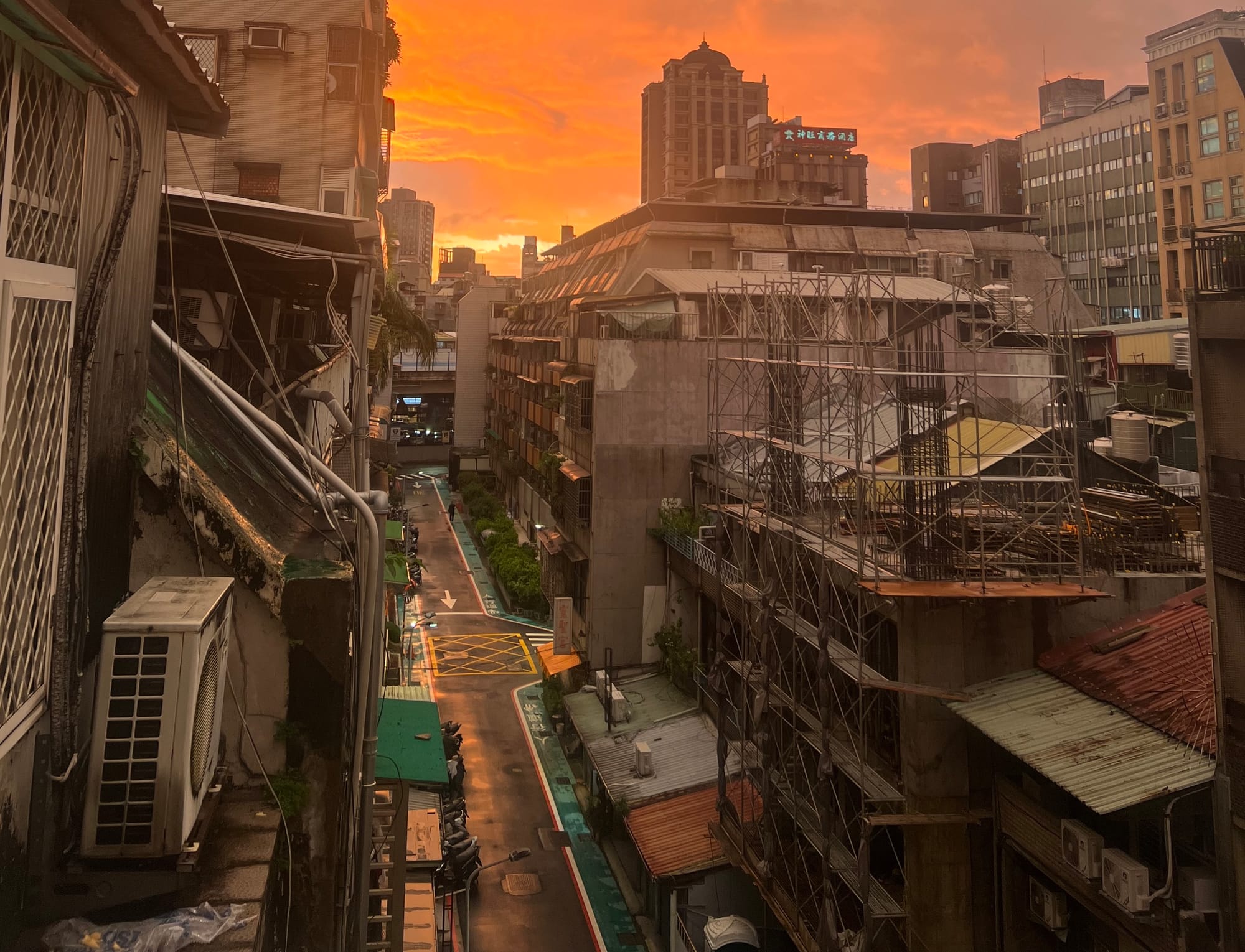
If Taipei has a prototypical scene, it’s this. Rainwater accumulates in puddles while the sun pokes through what remains of the storm clouds. People on mopeds are the first to break the silence. They charge down the narrow alleys, their ponchos flapping around them in a shroud. The city’s brick walls—an architectural choice as ubiquitous as it is puzzling—take on a darker hue in the damp.
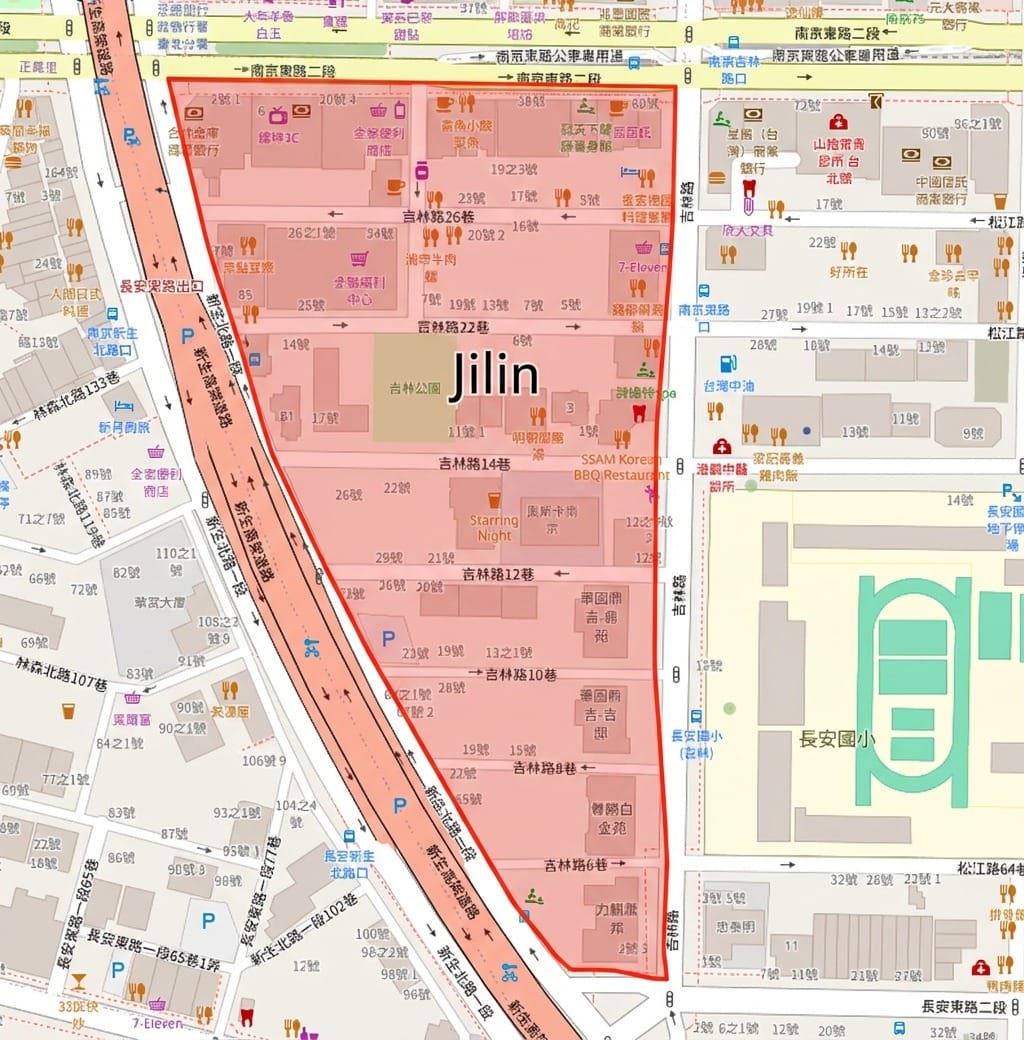
The neighborhood pictured above is called Jilin. I lived here for all of 2024 while I attended National Taiwan University, the island’s primary public university. It consists of ten square blocks tucked into the corner formed by the Xinsheng overpass and one of Taipei’s main thoroughfares, Nanjing East Road.
At its widest point running east to west, the neighborhood spans only 200 meters. Its southern tip stretches down 400 meters from the northern boundary. Like much of Taipei, zoning is largely unrestricted. At street level, restaurants, shops, and businesses compete for attention. Walk-up residences, mostly ancient apartment buildings, stretch their rusting bulk upwards five floors into the sky. Every morning elderly residents gather in Jilin Park, the neighborhood’s mossy centerpiece, slapping sense into their limbs.
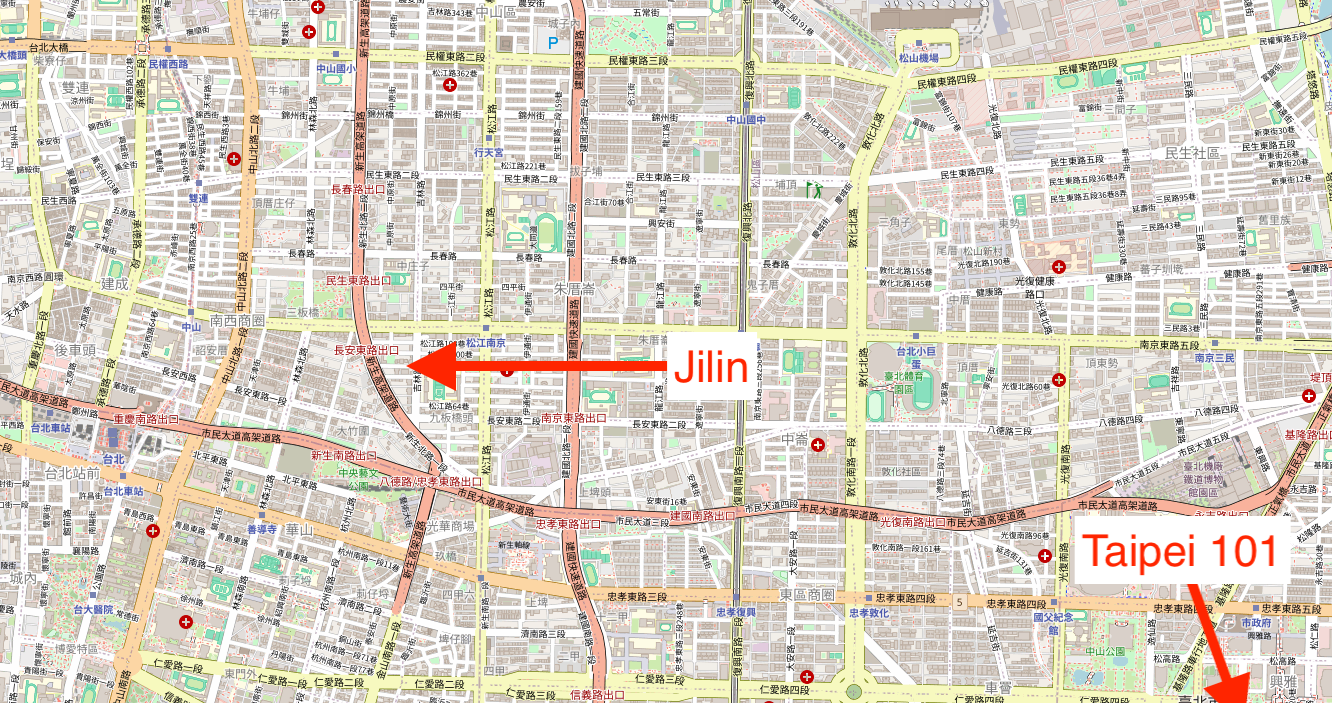
Neighborhoods such as these are the primary unit of Taipei’s urban planning. Passing between them usually involves crossing one of the city’s broad, six-lane arteries, which—given long traffic lights and the taboo against jaywalking—is a time-consuming task. As a result, I became acquainted with the rhythm of life in Jilin more than anywhere else.
For many, Taiwan remains an abstraction, a happy-go-lucky place of street food and night markets hoisted up by its booming semiconductor industry. Indeed, in Jilin you can almost hear the rumble of TSMC’s headquarters 50 miles away. Yet now more than at any other point in history, Taiwan’s specific striations have taken on especial importance. In this inaugural article, I hope to highlight a few of them.
Taipei’s urban history
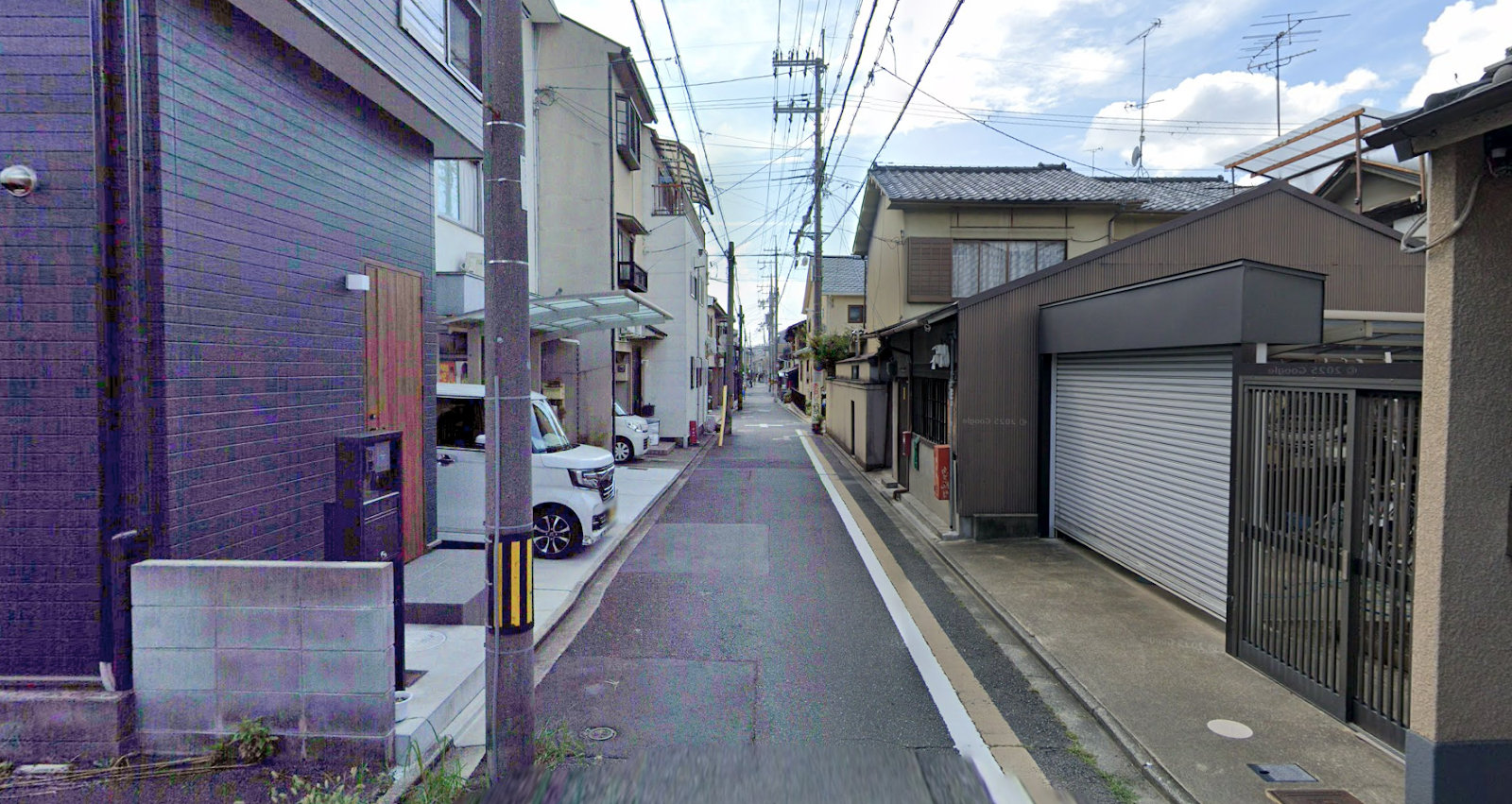
Visitors to Taipei are often struck by its resemblance to cities in Japan. In the summer of 2017 I spent several months backpacking around Russia and Asia. With fall bearing down on me, I flew from Japan, where I had traveled the length of the country, to Taiwan. I knew little about the place, let alone its history. When I stepped out of Taipei Main Station I could not help but feel that I had scarcely left.
Taipei’s urban development can be divided into four eras: the tail end of the Qing dynasty (–1895), Japanese occupation (1895-1945), Kuomintang (KMT) control (1945-1994), and the democratic era (1994-).
The rulers in each of these eras have tried their best to cow the city into submission, to mixed results. Even in the beginning, Taipei’s residents perfected NIMBYism with Chinese characteristics. They successfully resisted Japan’s destruction of imperial infrastructure, leaving four of the five imperial city gates intact.
Under the KMT, authoritarian leaders battled with squatters, whose abodes comprised 30% of the city’s housing supply in 1960. Some 12,000 of them previously occupied the current site of Taipei’s Da’an Forest Park, the largest public park in the city.
Outside of a handful of areas chosen for development, Taipei’s democratic politicians have spent three decades locked in battle with landowners, whose property values have reached astonishing heights. According to Taipei’s city government, the average resident must save for 16.4 years to afford to buy a house.
Taiwan’s Japanese colonial overlords probably had the greatest influence on the city today. They laid the foundation of modern Taipei. At the time of the Japanese invasion in 1895, Taipei was a traditional walled city (the last in imperial China) that had only finished construction in 1884. The Japanese nonetheless demolished the city walls in the early 20th century in an effort to fold Taipei into other settlements nearby. They also constructed the city’s wide, tree-lined avenues, several of which are still present today.
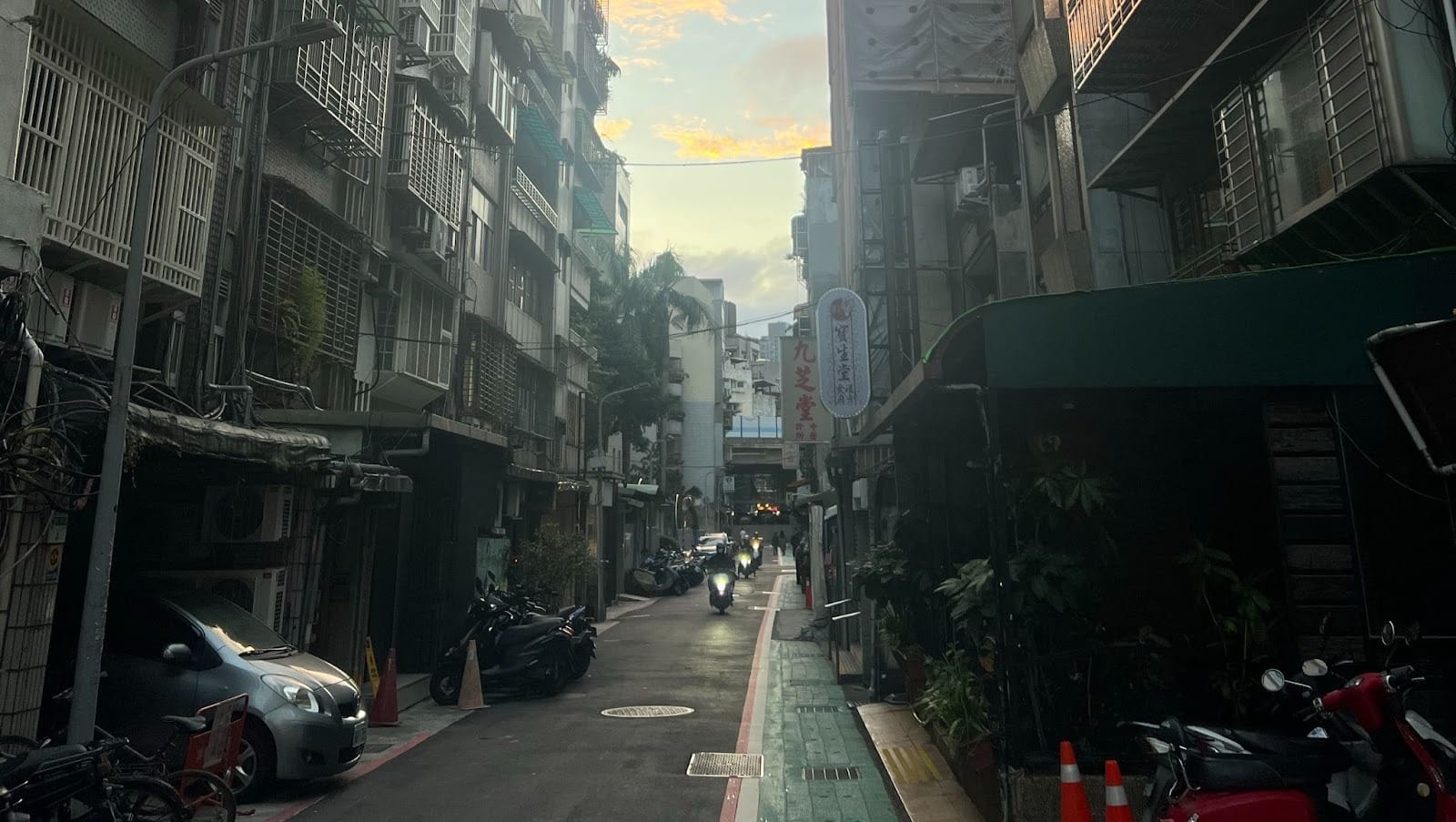
At a micro level, Taiwan’s aesthetic preferences are still aspirationally Japanese, though it has developed its own indigenous style. Witness, in the photos above, the banks of iron bars that cover the windows of lower floors. Taiwan’s pedestrian walkways, which vehicles hardly avoid in the best of times, always have the same red, white, and green pattern.
You don’t have to see much of the city to notice that much of it appears to be in decay. Its government has made an effort to pour its vision of dreamy urbanism into all of the cracks it can. But it has little appetite for confronting the established interests that paralyze Taipei’s development. In the meantime, everyday Taiwanese continue to exercise creativity to overcome some of the highest housing costs in the world. The building in which I lived, a faddish “coliving space” with a chirpy Instagram account, was an illegal refurbishment.
Boba
Most foreigners' sole impression of Taiwan is as the home of milk tea. The Jilin Road neighborhood alone had four milk tea shops while I was living there. In its traditional conception, the beverage consists of black tea, milk, ice, and tapioca pearls, sweetened to taste. Confusingly, both the drink and the tapioca are often rendered in English as “boba”, in addition to the somewhat more downmarket “bubble tea”. The drink’s ubiquity in Taiwanese culture has even led the island’s government to use it in its efforts to curry favor abroad: when I visited TECRO, Taiwan’s representative office in Washington, they served us milk tea.
In Taipei you can hardly walk a single city block without coming across at least one milk tea store. Unlike in the West, it’s not a decadent, dessert-adjacent treat, but a daily ritual. Even the fanciest milk tea rarely exceeds NT$60 (US$2). Couples pride themselves on knowing their partner’s favorite order.
One’s brand of choice is predictive of age and socioeconomic status. (Dejeng if you’re hip and unscrupulous, 50 Lan if you’re over 35.) Competition between milk tea chains is fierce: in the year that has elapsed since I left Taiwan, two neighborhood stores closed permanently and two others arrived.
Yet Taiwan has largely failed to export its version of the drink abroad. This will come as a surprise to most non-Taiwanese. If you’ve spent any time at all in an American urban center in recent years, you will have noticed the spread of shops purporting to sell the stuff. But the milk tea on hand in America would be almost unrecognizable to everyday Taiwanese.
This is primarily due to the influence of brands hailing from mainland China. Think mochi sludge, cream tops, cheese, fruity pustules, pistachio “clouds”, and black sesame “tornadoes”. (One wonders how beverages became so meteorological.) The easiest way to tell whether a brand actually hails from Taiwan is to inspect its cups: if they’re opaque, you know you’re in good hands.
Just as with so many other things, Taiwan largely sticks to the script: choose a tea, one of two types of milk (powdered or fresh), a sugar level, ice, and one of a small number of toppings. It is better for it.
Stores, etc
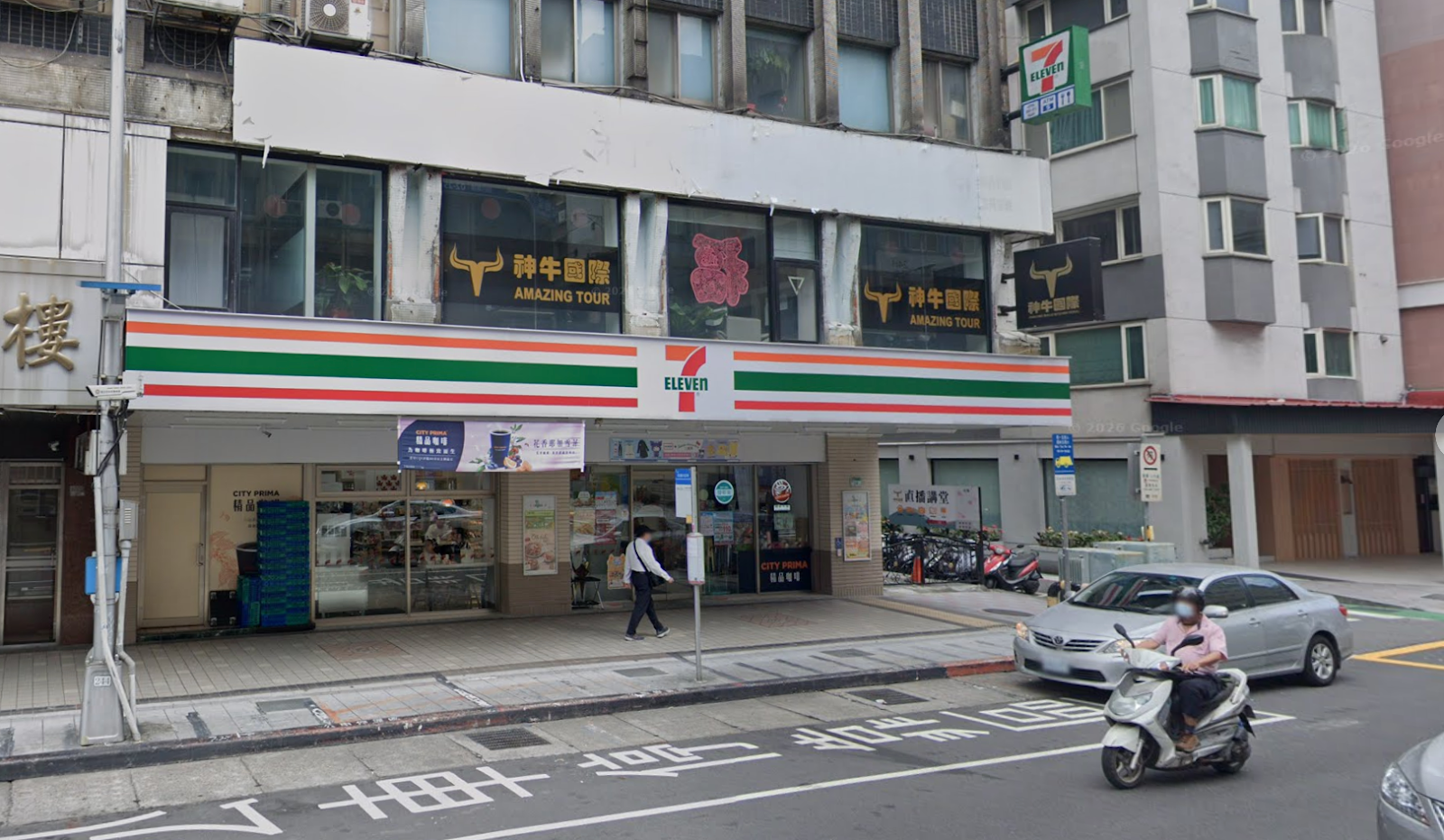
The Jilin neighborhood features a 7-Eleven on its eastern flank. Taiwan’s dueling convenience store chains, 7-Eleven and FamilyMart, provide a range of services and products to the island’s denizens. Even in remote areas, the glow of their storefronts at night is distinctive and omnipresent. Much ink has been spilled about the wonders of Japanese konbini, and the Taiwanese version makes few alterations to the format. In addition to serving up milk tea and passable late-night meals, these stores also offer the receipt and delivery of packages, dependable ATMs, and tolerable coffee.
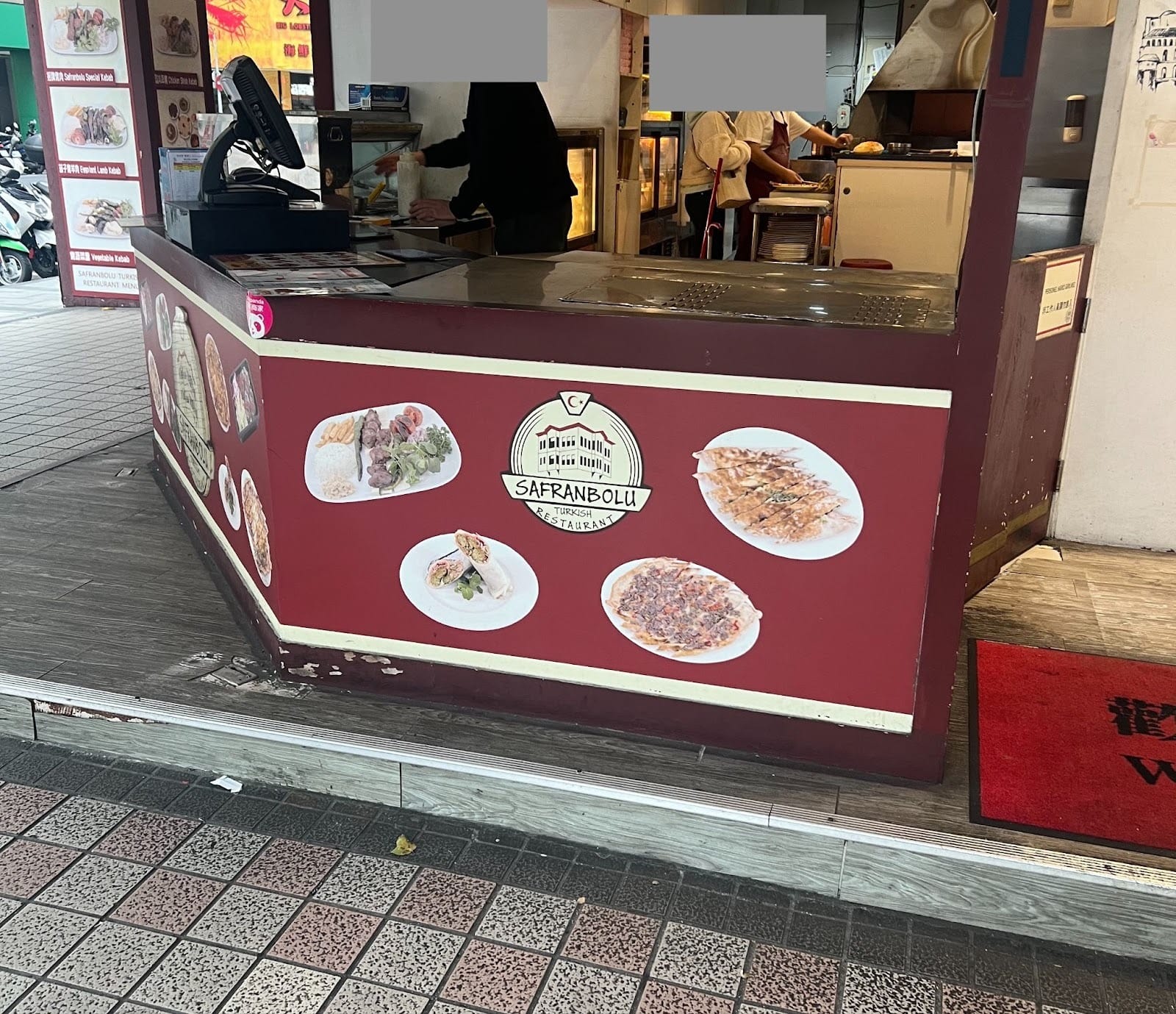
On the northeast corner of Jilin there is a Turkish restaurant that should be judged more favorably by its dreams than its achievements. The broader region just north of Jilin is known for its population of immigrants, with a particular concentration of Vietnamese. Here you’ll also find decent Thai food, South Asian, and, in the old red light district to the west, marginally more authentic Japanese. However, most foreign cuisine in Taipei has been subjected to slow Taiwanification, both because of the city’s meager flow of immigrants and the general adaptation of foreign dishes to the palate of the majority. With each passing decade, Taiwan’s Japanese cuisine resembles that found in Japan less and less, yet it has turned this into a strength.
The island’s precariousness is visible even here. Just north of Jilin Park is an air raid shelter, the entrance of which is hidden between two storefronts. When I moved in, the person who received me at my coliving space was careful to point out its presence, a little tongue in cheek. More than once, when what turned out to be an F-16 screamed overhead, I raced out of bed and looked to the sky, blinking into the morning twilight until I made a positive identification.
Cities are luckier than us: they often look much like they did in their glory days. Taipei is no exception. More than most places, it seems stuck in the nineties. Payphones dot street corners. Most everyday transactions use cash. But it is one of the few remaining oases of authentic grunge in the sinophone world. Heavy metal bands hold illicit concerts underneath rainswept bridges. People change their names because a fortune-teller portends the worst. Change is coming, whether at the hands of political calamity or the charging bronco of semiconductors, which helped buoy the island’s GDP growth to 8.68% in 2025. Like many, I hope that a new heyday for Taipei is on its way.